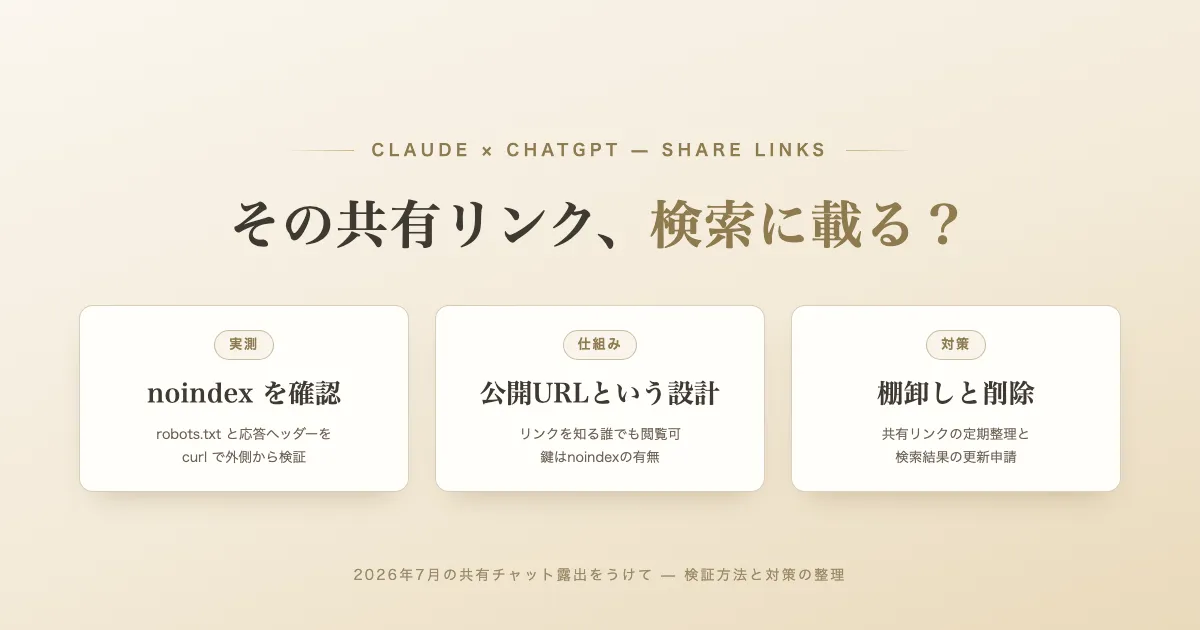
Around July 27, 2026, a warning post spread on X claiming that “Claude’s share button creates not a private link but a public page that search engines can crawl,” and it was in fact reported that shared Claude chats were appearing in Google Search results. How accurate is this claim, and what is the situation now? In this article I organize the reporting, measure the shared pages of both Claude and ChatGPT directly, and summarize the countermeasures available to users (all measurements were taken on July 29, 2026).
What happened
First, take a look at these search results for yourself.
Open the results for site:claude.ai/ internet in a new tab
site: is a search operator that restricts results to a specific domain, and this query asks for “pages under claude.ai that contain the word ‘internet’.” Swap the keyword and you can narrow to any topic the same way. When the incident came to light, searching the share path in this manner (site:claude.ai/share) was enough to bring up a list of shared chats from complete strangers.
According to TechCrunch, over the weekend Reddit users discovered that entering the search operator site:claude.ai/share into Google surfaced a long list of shared chats; 404 Media first reported the story on July 27, 2026 (local time), with TechCrunch and others following. The exposed conversations reportedly included medical records, clinical-trial results with patient names, and corporate documents marked internal-only.
Anthropic told TechCrunch that it does not provide chat directories or sitemaps to search engines and that shared-link URLs are not guessable. When TechCrunch searched again that afternoon, the results had largely stopped appearing. The same article notes that in September 2025, Forbes had reported roughly 600 Claude chats indexed on Google; and ChatGPT had a similar incident in late July 2025, after which OpenAI retired its opt-in checkbox for making chats discoverable by search engines — calling it a “short-lived experiment” — by August 1, 2025.
Direct measurements — as of July 29, 2026
I checked whether the reported state still holds, within what can be observed from the outside.
robots.txt
First, both services’ robots.txt files.
$ curl -s https://claude.ai/robots.txt
User-Agent: *
Disallow: /share/*
(excerpt: the share path is disallowed for all crawlers)

$ curl -s https://chatgpt.com/robots.txt
User-agent: *
Allow: /share/
(excerpt: the share path is explicitly allowed)
The two responses are strikingly opposite. Claude refuses crawling of the share path altogether, while ChatGPT permits it.
The shared pages themselves
Next, the responses of real share links published on the web (conversation IDs redacted).
$ curl -sI https://claude.ai/share/<conversation-id>
HTTP/2 200
x-robots-tag: none        ← equivalent to noindex, nofollow

$ curl -s https://chatgpt.com/share/<conversation-id> | grep -i robots
<meta name="robots" content="noindex,nofollow"/>
Both return a directive that forbids search engines from indexing the page (noindex) — Claude via an HTTP header, ChatGPT via a meta tag in the HTML. A Google search for site:claude.ai/share at the time of checking returned no shared chats themselves, only news articles.
What has not changed
Meanwhile, both shared pages return HTTP 200 with no login and can be viewed by anyone. This is not a bug but the design, and both companies’ official documents state it explicitly.
Anyone who has access to a shared link can view the linked conversation. We encourage you not to share any sensitive content, as anyone with the link can access the conversation or share the link with other people.
(Anyone with access to a shared link can view the linked conversation; because anyone with the link can access it or pass it on, sharing sensitive content is discouraged)
Claude’s Help Center likewise explains that anyone with the link can view the chat snapshot (on Team and Enterprise plans, sharing is limited to members of the same organization).
In short: of the claims in the original post, “shared pages are public URLs with no authentication” remains true today, while “they get indexed by search engines” is — at least at present — blocked by the noindex directives.
The mechanism — why did indexing happen?
A question remains: if the URLs are unguessable, why did they appear in search results? Search engines discover URLs by following links placed on web pages. Once a share link is posted anywhere — social media, a forum, a blog — crawlers can reach it. And if the page it leads to carries no directive forbidding indexing, inclusion in search results is normal behavior. The crux of the problem is therefore not URL guessability but whether the public page carried noindex.
Here the relationship between noindex and robots.txt deserves attention. Google’s official documentation states:
For the
noindexrule to be effective, the page or resource must not be blocked by a robots.txt file, and it has to be otherwise accessible to the crawler.(For noindex to work, the page or resource must not be blocked by robots.txt and must be accessible to the crawler)
robots.txt only stops crawling (retrieval of content); it is not a mechanism that directly forbids indexing (inclusion in search results). If crawling is refused, the crawler cannot read the noindex attached to the page, and room remains for the URL to be listed in search results — known only from external links, without any content snippet. From this standpoint, ChatGPT’s configuration — allow crawling and let the crawler read the meta noindex — is the textbook method aligned with Google’s explanation, while Claude’s combination of a crawl ban with a noindex header carries the possibility that the noindex is never read by the crawler (though the crawl ban itself does prevent retrieval and display of the conversation content).
How to verify this yourself
Everything above can be reproduced by anyone, with no special access.
- Search operators — search
site:claude.ai/shareandsite:chatgpt.com/shareon Google or Bing and see whether shared pages appear. If you are worried about your own conversations, search for a distinctive sentence from the conversation in quotation marks combined withsite: - robots.txt — check how the share paths are treated, e.g.
curl https://claude.ai/robots.txt - Checking noindex — run
curl -Iagainst a share link to inspect theX-Robots-Tagheader, and view the page source for<meta name="robots"> - Confirming public access — open your own share link in a private window (logged out) and confirm it renders with no authentication
- Checking archives — look up the URL on the Wayback Machine (web.archive.org). Even after disappearing from search results, copies may remain in archives
Countermeasures
For users
- Audit and delete share links — In ChatGPT, you can list and delete your share links under Settings → Data Controls → Shared links → Manage. In Claude, you can invalidate a link by returning its visibility to Private from the chat’s share menu
- Treat share links as fully public URLs — do not create share links for conversations containing personal or confidential information; for limited sharing, use screenshots or text excerpts instead
- If something was already indexed — unshare first, then request an update through Google’s Refresh Outdated Content tool. If the page was saved by archive sites, request removal through each site’s process
- ChatGPT-specific caveat — someone who opens your share link can import the conversation into their own history. The official FAQ states that deleting the link does not remove copies imported on the other side
For organizations
- Make clear in usage policy that creating a share link is equivalent to publishing outside the company
- Use the sharing restrictions of Team and Enterprise plans (organization-only)
Summary
- On July 27, 2026, it was reported that shared Claude chats could be found through Google Search; conversations including medical records and internal-only documents were reportedly viewable
- In measurements on July 29, 2026, both Claude and ChatGPT attach noindex to shared pages (Claude via an
x-robots-tag: noneheader, ChatGPT via ametatag), andsite:searches no longer return shared chats themselves - However, the “anyone with the link can view, with no authentication” design is unchanged on both services and is stated in their official documents. It is safest to treat share links as general publication, not limited sharing
- What decides indexability is not the difficulty of guessing a URL but the presence of noindex. Google’s official documentation states that noindex only works when the page is not blocked by robots.txt, so combining a crawl ban with noindex calls for caution
- The basics of mitigation: audit and delete share links regularly, do not share sensitive conversations, and if content was indexed, file removal requests (e.g., Google’s refresh tool)
References
- Share and unshare chats — Claude Help Center (viewed July 29, 2026) — the official explanation of share-link visibility and the unsharing procedure
- ChatGPT Shared Links FAQ — OpenAI Help Center (viewed July 29, 2026) — the official explanation of share-link behavior, management, and deletion
- Block Search indexing with noindex — Google Search Central (viewed July 29, 2026) — the official specification of noindex and its relationship to robots.txt
- Refresh outdated content in Google Search — Google Search Help (viewed July 29, 2026) — the official tool for requesting search-result updates for deleted content
- PSA: Your Claude shared chats and Artifacts may have ended up on Google — TechCrunch (July 27, 2026) — reporting on the incident, the exposed content, and Anthropic’s comment
- ChatGPT kills Google-indexable chats over privacy fears — Search Engine Land (August 2025) — reporting on the similar 2025 ChatGPT incident and the retirement of the opt-in feature
- Post by @alex_prompter — X (around July 27, 2026) — the post that prompted this article