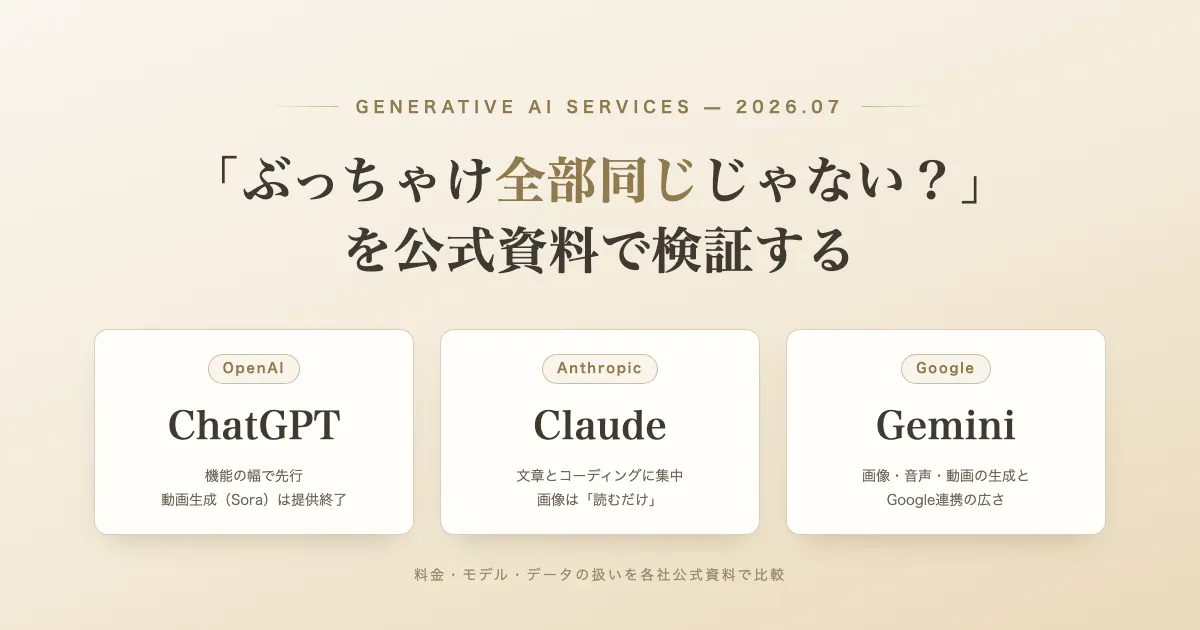
The other day, a friend asked me, “Which generative AI service should I use?” and I gave the blunt reply, “Honestly, if you can just ask what you want in your own language, aren’t they all pretty much the same?” As the one who said it, I was left with a nagging doubt about whether that was really good enough. So in this article, I test how far that answer actually holds by reading and comparing the official sites, official help pages, and official documentation of the three major services — ChatGPT (OpenAI), Claude (Anthropic), and Gemini (Google). Rather than each company’s marketing copy, I use only the facts written on their pricing pages, terms of service, and help articles (all prices and model names are as confirmed on 21 July 2026).
The Conclusion First — A Comparison Table
| Item | ChatGPT | Claude | Gemini |
|---|---|---|---|
| Developer | OpenAI (USA) | Anthropic (USA) | Google (developed by Google DeepMind) |
| Latest models | GPT-5.6 Sol | Claude Fable 5 / Claude Sonnet 5 | Gemini 3.1 Pro / Gemini 3.6 Flash |
| Free plan | Yes | Yes | Yes |
| Paid personal (monthly) | Go $8 / Plus $20 / Pro $100+ | Pro $20 / Max $100+ | Plus ¥1,450 / Pro ¥2,900 / Ultra $100+ |
| Apps | Web, iOS, Android, macOS, Windows | Web, iOS, Android, macOS, Windows, Linux (beta) | Web, iOS, Android (also integrated into Android OS) |
| API | Yes | Yes | Yes |
| Image reading | Yes | Yes | Yes |
| Image generation | Yes | No (reading only) | Yes (Nano Banana family) |
| Voice conversation | Yes | Yes (beta) | Yes (Gemini Live) |
| Video generation | No (Sora discontinued) | No | Yes (Veo 3.1) |
| Training on your conversations | Can be turned off in settings | Chosen in settings | Can be turned off in settings |
Even just looking at the table, the rough verdict on the opening answer starts to come into view. The entry-level experience of “ask a question in your own language and get an answer” really is nearly identical across all three. Each has a free plan, a standard plan around $20, and a top-tier plan in the $100 range, plus a mobile app and an API — this skeleton lines up neatly across the three companies. On the other hand, clear differences remain around the “periphery”: video and image generation, integration with other services, and data handling. Below, I confirm each company against its official sources, one at a time.
ChatGPT (OpenAI) — Leading on Breadth of Features
The developer is OpenAI. In the privacy policy, the data controller is listed as OpenAI OpCo, LLC (San Francisco, USA).
The latest model is the flagship reasoning model GPT-5.6 Sol, whose rollout began on 9 July 2026. The official model release notes describe it as being for complex work such as coding, research, science, cybersecurity, computer use, and design (it is for paid plans; the everyday default model on the free version is GPT-5.5 Instant).
Pricing (official pricing page, in US dollars):
- Free ($0) — GPT-5.5 Instant with usage limits. Caps on message count, uploads, image generation, and so on
- Go ($8/month) — A budget plan with raised limits. Notably, it explicitly states that “ads may be shown”
- Plus ($20/month) — GPT-5.6-series reasoning models, expanded Deep Research, projects, custom GPTs, and more
- Pro ($100/month+) — Two tiers of 5x or 20x usage. Image generation becomes fast and unlimited
- For businesses, there are Business ($25/user/month, or ¥3,050/user/month billed annually) and Enterprise (price undisclosed)
Supported platforms are Web, iOS, Android, macOS, and Windows, plus an officially provided Chrome extension. The API (OpenAI API) is usage-based, and the latest GPT-5.6 series comes in three variants by use case: Sol (input $5 / output $30 per million tokens), Terra ($2.50 / $15), and Luna ($1 / $6).
On image, audio, and video, ChatGPT offers image reading and generation and voice conversation within the app, while the video generation service Sora was discontinued on the web and app on 26 April 2026 (the official help page states, “The Sora web and app experiences were discontinued on April 26, 2026.” The API is also scheduled to end on 24 September 2026). In other words, ChatGPT at present is a service without video generation.
On data handling, for personal use, conversations may be used to improve (train) the model, and turning off the “Improve the model for everyone” setting stops them from being used for training. There is also a “temporary chat” that is not used for training and is automatically deleted after 30 days.
Claude (Anthropic) — Focused on Writing and Coding, With Images “Read Only”
The developer, Anthropic, is a Public Benefit Corporation that positions itself as an “AI safety and research company.”
The latest model is Claude Fable 5 (described in the official model list as “our most capable generally available model”), which became generally available on 9 June 2026, while the default model on the Free and Pro plans is Claude Sonnet 5, released on 30 June 2026. Alongside these are Claude Opus 4.8 (for agentic coding) and Claude Haiku 4.5 (fastest and lowest cost). The context (the amount of text it can handle at once) is up to 1 million tokens.
Pricing (official pricing page, in US dollars):
- Free ($0) — Chat, code generation, web search, memory, and more
- Pro ($20/month, or $17/month billed annually) — Expanded usage limits, plus various tools such as Claude Code (coding assistance)
- Max ($100/month+) — Two tiers of 5x or 20x usage
- For businesses, there are Team ($25/user/month+) and Enterprise
Supported platforms are Web, iOS, Android, macOS, and Windows, plus official support for Linux (beta) and ChromeOS — the broadest configuration of the three companies. The API is offered directly at api.anthropic.com and also available via Amazon Bedrock, Google Cloud, and Microsoft Foundry.
Image, audio, and video is where the three companies differ most. Images are supported for reading (understanding and analyzing their content), but generation is not possible. The official documentation states the following.
Claude is an image understanding model only. It can interpret and analyze images, but it cannot generate, produce, edit, manipulate, or create images.
(Claude is an image understanding model only. It can interpret and analyze images, but it cannot generate, produce, edit, manipulate, or create images.)
Voice conversation is available on all plans as a beta, and video generation and input are not supported. Rather than broadening its features, it is a configuration narrowed to writing, coding, and reading long texts.
On data handling, the Free, Pro, and Max plans let users choose in settings whether to allow training use. If training is allowed, chats are retained for up to five years; if not, they are retained for 30 days as before (business plans and the API are excluded from training).
Gemini (Google) — Breadth of Multimodal Generation and Google Integration
The developer is Google, with model development handled by its integrated AI division, Google DeepMind.
The latest model is Gemini 3.6 Flash, announced — as it happens — on the same day as this article, 21 July 2026 (the official blog states it is available to all users of the Gemini app and via the API from that same day). For more advanced reasoning, Gemini 3.1 Pro (officially described as the “most intelligent model”) and Gemini 3.1 Deep Think are available on higher-tier plans. The fact that the version numbers do not align across series — the Flash series at 3.6 and the Pro series at 3.1 — is exactly as stated officially.
For pricing, Gemini is the only one of the three where Japanese yen can be confirmed on the official page:
- Free — The Gemini app with usage limits
- Google AI Plus (¥1,450/month) — Raised usage limits, Gemini within Gmail, and more
- Google AI Pro (¥2,900/month) — Pro models, Deep Research, 5TB of storage, and more
- Google AI Ultra (two tiers of $100/month and $200/month) — 5x/20x the usage of Pro (an official price in Japanese yen could not be confirmed)
Supported platforms are Web, iOS, and Android; in place of a dedicated desktop app, integration with Android OS, Chrome, and Google Workspace (Gmail, Docs) has advanced. The API (Gemini API) lets you issue a key in Google AI Studio, with a business offering via Vertex AI.
Image, audio, and video are the most extensive of the three: image generation with Nano Banana 2 / Nano Banana Pro, voice conversation with Gemini Live (including real-time voice translation in more than 70 languages), and video generation with Veo 3.1. Of the three companies, Gemini is the only one offering video generation as a current service (as noted, ChatGPT’s Sora has been discontinued, and Claude does not support it).
On data handling, turning on “activity saving” means chats are used to improve the service (including training the model), and turning it off means future chats are not used for training. The official help states that human reviewers may examine some chats for improvement, and that the default retention period is 18 months (72 hours when off).
How Far Was “They’re All the Same” Correct?
Having laid out the official sources, let me return to the opening answer and organize the result.
The parts where “the same” is fair to say — The central uses of getting a text answer to a question in your own language, showing an image and asking about its content, and requesting research can all be started for free at all three companies, and the pricing skeleton — a standard plan around $20 and a top-tier plan in the $100 range — even matches. If the friend’s question was about “wanting to use it for everyday research and writing,” the opening answer is largely not wrong. Whichever you choose, the entry-level experience differs little, so try the free plan first and use whichever feels easiest to talk to — that is the answer as far as the official sources allow.
The parts where they are “not the same” — The choice changes if you care about the following three points:
- What you want to generate — If you want to create video, the options narrow to Gemini (only Gemini has video generation as a current service). If you need image generation, then ChatGPT or Gemini. Claude can “read” images but cannot “draw” them
- What environment you use it in — For Gmail and Google Docs, Gemini’s integration is the deepest; for the breadth of dedicated apps including a Linux desktop, Claude; and for the lineup of Chrome extensions and Windows/macOS apps, ChatGPT is no less capable
- Data handling and the fine print on pricing — All three let you stop conversations from being used for training via settings, but the default behavior, retention period, and opt-in/opt-out method each differ. There is also individuality in the budget tiers, such as ChatGPT’s Go with ads at $8 and Gemini’s Plus from ¥1,450 in yen
There is one topic this article did not address: the superiority of the models’ performance (intelligence) itself. This cannot be judged from each company’s official sources — that is, from self-reporting. Mechanisms by which third parties evaluate models (benchmark sites and user voting) are organized in the follow-up piece, “Who Measures the ‘Intelligence’ of Generative AI, and How?”.
Summary
- “If you can ask in your own language, they’re all the same” is largely correct as far as everyday chat use goes. The skeleton of a free plan, a standard plan around $20, a top-tier plan in the $100 range, apps, and an API lines up across all three
- The differences remain around the periphery. Video generation is Gemini only; image generation is ChatGPT and Gemini; Claude is image reading only
- The depth of integration varies by company: Gemini with Google services and Android, Claude with breadth of OS support (including Linux beta), and ChatGPT with breadth of features and a Chrome extension
- All three let you control training use of conversations in settings, but the defaults, retention periods, and opt-in/opt-out methods differ, so business use warrants a check
- The superiority of performance cannot be judged from official sources. Third-party evaluation mechanisms are covered in the follow-up
References
- ChatGPT Pricing — OpenAI (confirmed 21 July 2026)
- ChatGPT Business Pricing — OpenAI (confirmed 21 July 2026)
- Download ChatGPT — OpenAI (confirmed 21 July 2026)
- OpenAI API (confirmed 21 July 2026)
- Model Release Notes — OpenAI Help Center (confirmed 21 July 2026)
- Data Controls FAQ — OpenAI Help Center (confirmed 21 July 2026)
- What to know about the Sora discontinuation — OpenAI Help Center (confirmed 21 July 2026)
- Privacy Policy — OpenAI (confirmed 21 July 2026)
- Pricing — Claude (confirmed 21 July 2026)
- Download — Claude (confirmed 21 July 2026)
- Models overview — Claude Docs (confirmed 21 July 2026)
- Vision — Claude Docs (confirmed 21 July 2026)
- Using voice mode on Claude mobile apps — Claude Help Center (confirmed 21 July 2026)
- Updates to Consumer Terms and Privacy Policy — Anthropic (confirmed 21 July 2026)
- Company — Anthropic (confirmed 21 July 2026)
- Google One plans and pricing (confirmed 21 July 2026)
- Compare Google AI plans — Google One Help (confirmed 21 July 2026)
- Google AI subscriptions — Google official blog (confirmed 21 July 2026)
- Gemini 3.6 Flash announcement — Google official blog (confirmed 21 July 2026)
- Gemini models — Google DeepMind (confirmed 21 July 2026)
- Gemini API documentation — Google AI for Developers (confirmed 21 July 2026)
- Gemini Apps privacy and data — Google Help (confirmed 21 July 2026)