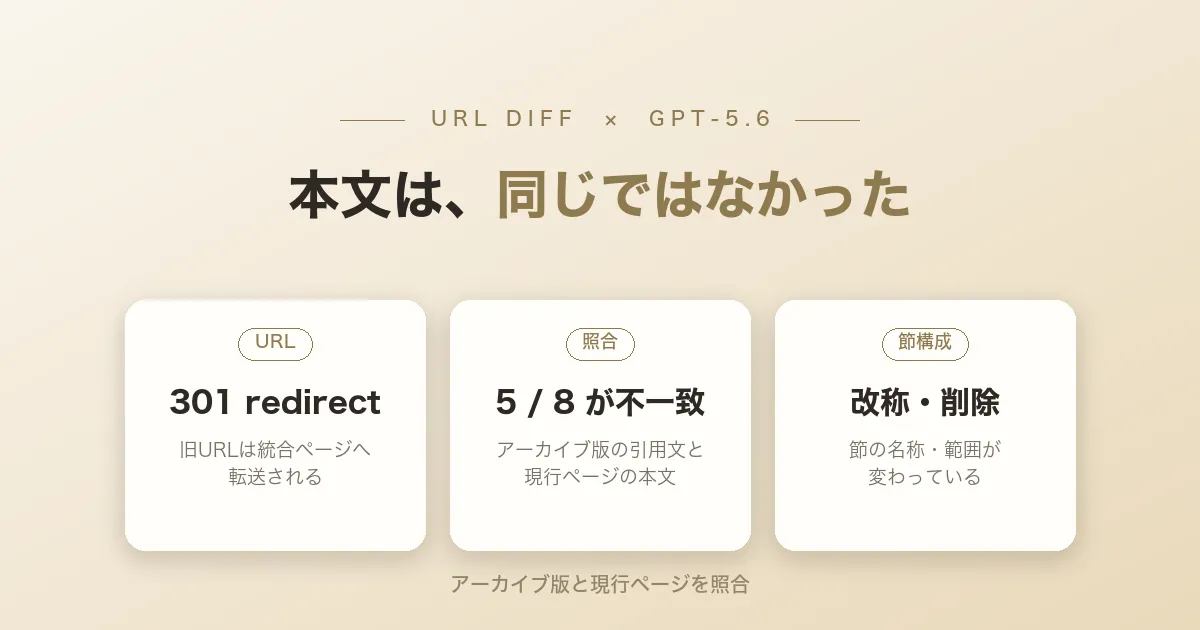
In our previous article, we organized the shift in prompt-design thinking based on the GPT-5.6 Sol prompting guide that OpenAI had published. Since then, the standalone page for that guide has disappeared, and the old URL now redirects to a broader “Model guidance” page. If the page had merely changed, swapping the source would have been enough. But comparing the body text, we found that many of the sentences our previous article quoted could not be found on the current page. In this article, we first show what disappeared and what remained, and then present the method and details of the comparison.
Conclusion — What disappeared were the “reasons” and “examples”; what remained were the “figures” and “definitions”
Of the eight sentences our previous article quoted, three remained verbatim on the current page, and five could not be found. Placing the two side by side, there is a clear pattern in what survived.
What remained are short, self-contained factual sentences.
- The figure showing the effect of simplification (a measured report that simplifying prompts improved the score on an internal coding-agent evaluation by 10–15%)
- The definition of the approval boundary (“Define what level of action each request authorizes”)
- The default conciseness of responses (“GPT-5.6 tends to be more concise by default than GPT-5.5”)
What could not be found are the rationales for “why it should be designed this way,” and the concrete instructions and example sentences for putting them into practice.
- The opening definition (the framing declaration that a prompt defines outcome, constraints, evidence, and completion bar)
- The rationale (“GPT-5-class models follow prompt contracts closely” — the explanation that you should write concisely because the model follows the prompt faithfully as a contract)
- The principle of practice (“Describe the destination rather than prescribing every step”)
- The example of a stopping condition (“After each result, ask whether the core request can now be answered with useful evidence”)
- The instruction forbidding narration of tool calls (“Do not ask the model to narrate routine tool calls”)
The very section that bundled these rationales and examples together — “Outcome-first prompts and stopping conditions” — also cannot be found on the current page. In other words, the design philosophy our previous article placed at its center — write from the outcome, and define stopping conditions — has been removed from the body text at the section level, together with the reasons and examples that supported it.
That said, the content was not lost entirely. Something close to what the opening definition covered remains in the “What is new” bullet list at the top of the page, as a shorter rephrasing (“outcome” → “underlying goal,” etc.). Details follow below.
What was compared with what
The two things compared are as follows.
- The archived version: the archive of the old standalone page “Prompting guidance for GPT-5.6 Sol” as of July 16, 2026 (the primary source of our previous article)
- The current page: the “Model guidance” page as of July 18, 2026 (the redirect target of the old URL)
When the old URL (https://developers.openai.com/api/docs/guides/prompt-guidance-gpt-5p6) was checked with curl on July 18, 2026, it returned HTTP 301, redirecting to /api/docs/guides/latest-model?model=gpt-5.6#prompting-best-practices. The instability we observed at the time of the previous article — “the display differs depending on the access environment” — has been resolved and replaced by a permanent redirect.
The comparison was done by extracting text from each HTML and searching for exact matches of the sentences our previous article quoted. Therefore, what this article calls “not found” means that no matching passage could be confirmed by exact match; it does not rule out the possibility that the content exists elsewhere in a reworded form.
Comparison results for the eight quoted sentences
| Content quoted in the previous article | Archived version as of 2026-07-16 | Current page as of 2026-07-18 |
|---|---|---|
| The opening definition, “prompts define the outcome, important constraints, available evidence, and completion bar” | Present | Not found |
| The effect of simplification (internal coding-agent evaluation, figures such as a 10–15% improvement in evaluation score) | Present | Present (wording matches) |
| The rationale “GPT-5-class models follow prompt contracts closely” | Present | Not found |
| “Describe the destination rather than prescribing every step” | Present | Not found |
| The stopping-condition example “After each result, ask whether the core request can now be answered with useful evidence” | Present | Not found |
| The approval-boundary definition “Define what level of action each request authorizes” | Present | Present (wording matches) |
| The response conciseness “GPT-5.6 tends to be more concise by default than GPT-5.5” | Present | Present (wording matches) |
| “Do not ask the model to narrate routine tool calls” | Present | Not found |
Incidentally, in the course of this comparison, we noticed that one quotation within the previous article (the sentence about response conciseness) did not match the body text of either the archived version or the current page. The actual sentence is “GPT-5.6 tends to be more concise by default than GPT-5.5.”, and the relevant passage in the previous article has been corrected together with the confirmation in this article.
Changes in section structure
Comparing the list of headings (anchors), there are also changes in the names and structure of the sections.
- “Simplify prompts first” → renamed to “Favor leaner prompts”
- “Tool routing” → renamed to “Make routing instructions task-specific”
- No section corresponding to “Outcome-first prompts and stopping conditions” could be found
- No section corresponding to “Long-running workflows and state” could be found either (the string “Long-running work” appears once on the page, but it is a navigation-menu item pointing to the Codex documentation, not a body-text section)
- “Personality, collaboration, and response length” is split into several sections, such as “Define the tone,” “Set response length and style,” “Set a default with text.verbosity,” and “Specify what a short answer must include”
- New sections such as “Choose programmatic tool calling by task shape,” “Pro mode,” and “Migrate to GPT-5.6” have been added
The part that remained in reworded form
Something close to what the opening definition covered remains in the “What is new” bullet list at the top of the current page, in the following form.
Intent understanding: GPT-5.6 can better infer the user’s underlying goal and intended level of work from context, so you often do not need to prescribe every step. Continue to provide domain context, hard constraints, approval boundaries, and success criteria.
(Intent understanding: Because GPT-5.6 can better infer the user's underlying goal and the intended level of work from context, you less often need to prescribe every step. Continue to provide domain context, hard constraints, approval boundaries, and success criteria.)
“outcome” becomes “underlying goal,” “important constraints” becomes “hard constraints,” and “completion bar” becomes “success criteria” — different words, but close concepts are used. However, this is not the very sentence our previous article quoted; it is a passage placed in a different context, “What is new.”
How to read this change
The current page is not a standalone prompting guide but a “Model guidance” page that covers the model overview, new features, migration steps, Pro mode, and prompt-design guidelines together. Given that sections such as “Migrate to GPT-5.6” and “Migrate with Codex” have been newly added, it seems likely that, as part of a reorganization of the documentation as a whole, the content of the old standalone page was restructured and relocated (this interpretation is not stated explicitly by OpenAI; it is speculation by this article). What remained as a result of the restructuring were short, verifiable factual sentences — “how much effect did what have” and “what is defined as what” — while what was removed were the rationales for “why it should be designed this way” and the examples that embody them. Reasons and examples help the reader understand, but they are also the kind of writing that goes stale quickly when the model’s behavior changes. One could take the view that, in consolidating into a general-purpose page, such short-shelf-life writing was organized away first — but this too does not go beyond speculation by this article. If you want to refer to the rationales and examples our previous article relied on, the practical consequence is that they can now be confirmed only in the archived version.
Summary
- The standalone prompting guide that was the source of our previous article has been merged into the “Model guidance” page, and the old URL is now a 301 redirect
- Of the eight quoted sentences, the three that were the effect figure and short definitions remained verbatim, and the five that were rationales, principles, and examples could not be found
- “Outcome-first prompts and stopping conditions” and “Long-running workflows and state” could not be found at the section level
- Content close to the opening definition remains in “What is new” in reworded form
- To refer to the removed rationales and examples, the archived version as of July 16, 2026 is required
References
- Prompting guidance for GPT-5.6 Sol — OpenAI Developers (archive as of July 16, 2026) — the primary source of the previous article. The “archived version” in this article’s text comparison
- Model guidance — OpenAI Developers (confirmed July 18, 2026) — the redirect target of the old URL. The “current page” in this article’s text comparison