The author uses Claude for daily work support, but running the flagship Claude Fable 5 as a constant workhorse reveals how quickly tokens are consumed. Looking into it, this turns out not to be something that clever usage can solve but a matter of pricing structure — and at the same time, Anthropic itself has presented two countermeasure configurations complete with measured figures. This article states the conclusion first, then organizes the underlying pricing structure, the mechanics and measured figures of the two strategies, the current state of the means to adopt them, and finally “which is the practical choice for now,” all based on official documentation and official announcements.
Conclusion — Don’t run Fable 5 constantly; use it in a cost-saving configuration. For now, the practical choice is Strategy A
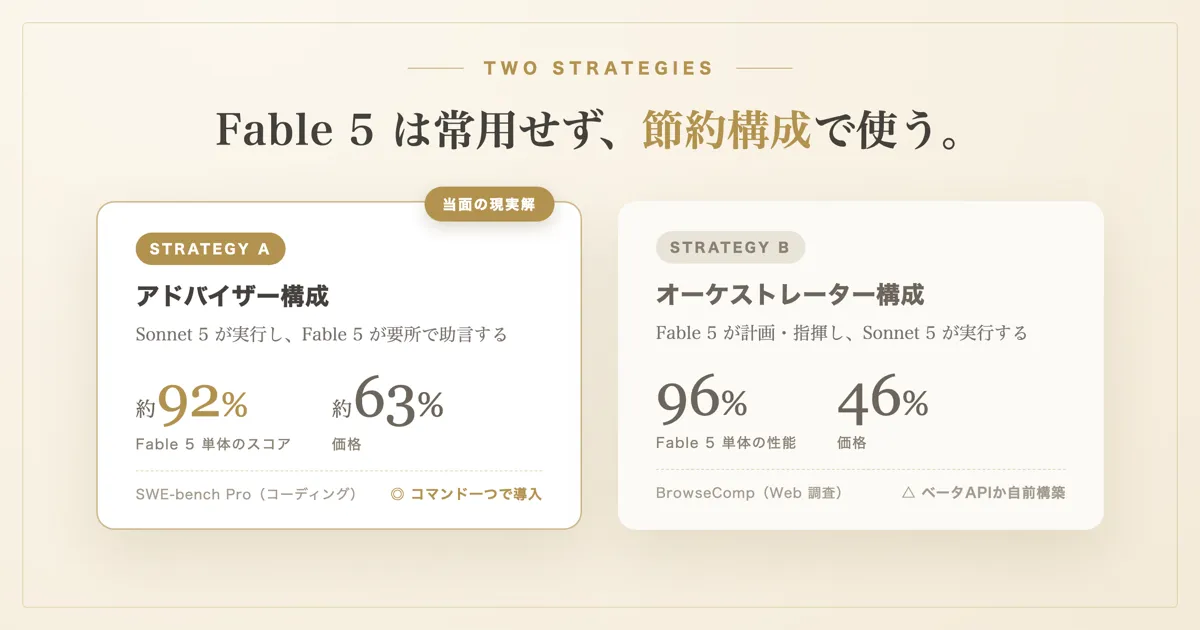
Using Fable 5 as the main model and having it write deliverables continuously is, as the next section shows, difficult to sustain under either API billing or a subscription. Instead, Anthropic’s official developer account @ClaudeDevs presented the following two configurations in a thread on July 8, 2026.
| Configuration | Division of roles | Official measured figures |
|---|---|---|
| Strategy A: advisor configuration | Sonnet 5 executes; Fable 5 advises at key moments | About 92% of Fable 5’s standalone score at about 63% of the price (SWE-bench Pro) |
| Strategy B: orchestrator configuration | Fable 5 plans and directs; Sonnet 5 workers execute | 96% of Fable 5’s standalone performance at 46% of the price (BrowseComp) |
The principle common to both is “don’t let the expensive model emit tokens.” Token-heavy output such as deliverables and voluminous research results is left to the cheaper Sonnet 5, and Fable 5’s role is limited to short advice, or to planning and direction.
However, the two configurations differ completely in ease of adoption. Whereas Strategy A can be enabled with a single Claude Code command, the means to run Strategy B are currently limited to a beta API feature or a self-built system (discussed later). Therefore this article’s conclusion is “for now, the practical choice is Strategy A.”
Why is it expensive — twice the unit price of Opus 4.8, plus about 30% more tokens
According to Anthropic’s official pricing table, the API prices (per million tokens) of the main models are as follows.
| Model | Input | Output |
|---|---|---|
| Claude Fable 5 | $10 | $50 |
| Claude Opus 4.8 | $5 | $25 |
| Claude Sonnet 5 * | $2 | $10 |
| Claude Sonnet 4.6 | $3 | $15 |
- Sonnet 5 is at an introductory price through August 31, 2026. From September 1 of the same year, it will become the same input $3 / output $15 as Sonnet 4.6.
For both input and output, Fable 5 is exactly twice Opus 4.8, and five times the introductory-price Sonnet 5.
Furthermore, an often-overlooked point: the same pricing page carries the following note.
Claude Opus 4.7 and later Opus models, Claude Fable 5, Claude Mythos 5, Claude Mythos Preview, and Claude Sonnet 5 use a newer tokenizer that contributes to their improved performance on a wide range of tasks. This tokenizer produces approximately 30% more tokens for the same text.
(Opus 4.7 and later Opus models, Fable 5, Sonnet 5, and others adopt a newer tokenizer that contributes to improved performance across a wide range of tasks, and it generates approximately 30% more tokens for the same text.)
In other words, Fable 5 is not only expensive per unit; the very number of tokens counted for the same work also increases over previous-generation models. When using Claude Code on a subscription (Pro/Max), this consumption is also counted against the plan’s usage limit (the Claude Code documentation explicitly states that the advisor usage described later counts against the usage limit), so running Fable 5 constantly as the main model is difficult to sustain under either API billing or a subscription.
Strategy A — Sonnet 5 executor × Fable 5 advisor
The foundation is the advisor tool announced by Anthropic on April 9, 2026. A cheap executor model drives the task all the way through, consulting a higher-tier advisor model only when a judgment is difficult — a configuration realized with a single API tool definition. @ClaudeDevs names Claude Sonnet 5 as this executor.
An executor (Sonnet 5) calls Fable 5 for guidance.
— ClaudeDevs (@ClaudeDevs) July 8, 2026
The post introduces a configuration in which the executor, Sonnet 5, calls Fable 5 for advice when a judgment is difficult, and the majority of tokens are billed at the cheaper executor’s unit price. According to the API documentation, the advisor reads the context of the executor’s work and returns only short advice (typically 400–700 text tokens), generating no final deliverable for the user. As the pricing table above shows, Sonnet 5’s unit price is exactly 1/5 of Fable 5 at the introductory price, and the expensive unit price applies only to the short advice portion.
The effect is shown in the measured figures published in the following post.
~92% of Fable 5's score at ~63% of the price.
— ClaudeDevs (@ClaudeDevs) July 8, 2026
On the coding benchmark SWE-bench Pro, this configuration achieves about 92% of Fable 5’s standalone score at about 63% of the price. Moreover, Fable 5 is called rarely per task (roughly once), with most of the work executed by Sonnet 5. The design of “consulting the higher-tier model only at key moments” is backed up even in the measured call frequency.
Strategy B — Fable 5 orchestrator × Sonnet 5 workers
The second strategy reverses the roles. It places Fable 5 as the orchestrator (commander) to handle planning and direction, and delegates the actual work to multiple Sonnet 5 workers (subagents). Here too, the majority of tokens are billed at the cheaper workers’ unit price.
Use Fable 5 as an orchestrator.
— ClaudeDevs (@ClaudeDevs) July 8, 2026
Measured figures were published for this as well. When the Web-research benchmark BrowseComp was measured on Claude Managed Agents, this configuration achieved 96% of Fable 5’s standalone performance at 46% of the price. This is because the research work that consumes a large volume of tokens is delegated to the Sonnet 5 side.
96% of Fable 5 performance at 46% of the price.
— ClaudeDevs (@ClaudeDevs) July 8, 2026
However, the means to run Strategy B are currently limited
The figures are more attractive than Strategy A’s, but there are currently only the following three routes to actually run it.
- Claude Managed Agents — the same route as the official measurement. According to the official documentation, it is offered in beta and enabled by default on all API accounts (only specifying a beta header is required; no application is needed). However, it is API-billing only, and in addition to token costs, a session execution time charge of $0.08/hour is added. Also, unlike Strategy A’s advisor tool, it is not covered by ZDR (Zero Data Retention).
- Approximate it with Claude Code subagents — set the main model to Fable 5 and specify the model in the subagent definition (
model: sonnet), and you can assemble a similar configuration within a subscription. However, there is no “enable with a single command” mechanism like the advisor tool, and whether the orchestrator delegates without doing the work itself depends on the prompt and agent design. No official measured figures for this route have been published either. - Build your own with the Agent SDK, etc. — a developer-oriented route that builds from the agent loop yourself.
All of these presuppose API billing or require a fair amount of design and construction. For the general user running Claude Code on a subscription, Strategy B is, at present, hard to count among the options for “trying it out easily.”
Note that these measured figures are results on Claude Managed Agents, and Claude Code does not come with an identically named “orchestrator mode” as-is. That said, Claude Code has a mechanism called subagents, which lets you define subagents by role and delegate work. So conceptually it can be applied to Claude Code as well, but the official measured figures themselves must be read as results on Managed Agents.
Which should you choose — Strategy A for the time being
In theory, the two configurations share the principle of “don’t let the expensive model emit tokens” while placing initiative in opposite ways. In Strategy A, the cheap model does the hands-on work and the higher-tier model devotes itself to steering. In Strategy B, the higher-tier model holds the plan and the cheap model does the hands-on work. The official measured figures were also taken in contrasting settings: on coding work that stacks up sequential judgments (SWE-bench Pro), Strategy A performed well, while on research work that can be delegated in parallel to many workers (BrowseComp), Strategy B did. The rule of thumb readable from the figures is A if the task is linear, B if the work can be divided.
In actual selection, however, the difference in means of adoption is decisive. Strategy A can be enabled with a single Claude Code command, and the published measured figures measured that advisor tool itself. Strategy B, on the other hand, can only use the beta API feature described above or be assembled yourself, and even approximating it with Claude Code subagents, there are no official figures backing up its effect. As long as you choose by ease and certainty, Strategy A will remain the practical choice for the time being.
Note that both figures are approximate numbers presented in the posts, each a measurement from a single benchmark. The official documentation itself carries the caveat “Results are task-dependent. Evaluate on your own workload.”
How to use the advisor tool
The method of enabling it is stated explicitly in the Claude Code documentation as follows.
The advisor tool is experimental and requires Claude Code v2.1.98 or later with the Anthropic API.
You can set the advisor model in three ways:
/advisorcommand: set or change the advisor mid-session and save it as your defaultadvisorModelsetting: configure a persistent default in your settings file--advisorflag: set the advisor for a single session at launch(The advisor tool is an experimental feature and requires Claude Code v2.1.98 or later and use with the Anthropic API. There are three ways to set the advisor model. The
/advisorcommand sets or changes the advisor mid-session and saves it as the default. TheadvisorModelsetting configures a persistent default in the settings file. The--advisorflag sets the advisor for a single session at launch.)
The timing of the call is decided by the model, but you can also explicitly instruct it to consult via the prompt. Note that using Fable 5 as the advisor requires v2.1.170 or later and your organization’s Fable 5 access.
There are constraints on model combinations. The advisor must be at least as capable as the main model, and Fable 5 can be the advisor for a Haiku, Sonnet, or Opus executor. On the other hand, when Fable 5 is the main model, the only allowed advisor is Fable 5. Strategy A’s combination conforms to this constraint. Conversely, keeping Fable 5 as the main model does not reduce token consumption even if you add an advisor (the main model keeps generating deliverables, and consumption increases by the advisor’s share).
Advantages and disadvantages
Advantages. First, the effect is quantitatively backed by official measured figures (about 92% of Fable 5’s standalone score at about 63% of the price on SWE-bench Pro). Second, it is easy to adopt; in Claude Code it can be enabled with a single command. Third, mechanisms to manage cost are provided, such as setting limits on the number of calls and the length of advice. Fourth, in Claude Code, switching /advisor mid-session does not invalidate the main model’s prompt cache. It is also covered by ZDR (Zero Data Retention).
Disadvantages. First, it is a beta / experimental feature, and its behavior, pricing, and availability may change. It is offered only on the Anthropic API (and Claude Platform on AWS) and cannot be used on Amazon Bedrock, Google Cloud, or Microsoft Foundry. Second, the advisor re-reads the entire conversation each time it is called. In Claude Code this reading is not cached, so if it is called frequently in a long session, the input token cost (usage-limit consumption on a subscription) swells. The API also provides a cache setting for the advisor, but the effect appears only from about three calls per conversation. Third, the call timing is up to the model, and there is no mechanism on the Claude Code side to force or cap the number of calls (only instructing via the prompt). Fourth, it is not suited to tasks with no room for planning, such as one-off Q&A. Finally, because the Fable 5 advisor’s responses are returned in an encrypted form, there is also an operational constraint that a human cannot directly inspect the content of the advice when using the API.
Summary
- Claude Fable 5’s unit price is twice that of Opus 4.8 (input $10 / output $50 per MTok), and on top of that, the new tokenizer increases the number of tokens counted for the same text by about 30%. It is a pricing structure that is hard to sustain for constant use as the main model.
- The solution presented by the official @ClaudeDevs is two configurations that “don’t let the expensive model emit tokens.”
- Strategy A (Sonnet 5 executor × Fable 5 advisor) achieves about 92% of Fable 5’s standalone score at about 63% of the price on SWE-bench Pro. It can be used right now with a single Claude Code command.
- Strategy B (Fable 5 orchestrator × Sonnet 5 workers) achieves 96% of Fable 5’s standalone performance at 46% of the price on BrowseComp. However, the means to run it are limited to a beta API feature (Claude Managed Agents) or a self-built system, and at present it is hard to count among the easy options.
- The theoretical rule of thumb is “A for linear coding, B for research that can be divided.” Factoring in ease of adoption and certainty of measurement, the practical choice for now is Strategy A.
- There are also constraints to grasp before adoption, such as the advisor tool being a beta feature, the advisor re-reading the entire conversation each time, and the Fable 5 advisor’s advice being returned encrypted.
References
- Pricing — Claude Platform Docs
- Advisor tool — Claude Platform Docs
- Escalate hard decisions with the advisor tool — Claude Code Docs
- The advisor strategy: Give agents an intelligence boost — Claude Blog (April 9, 2026)
- Claude Managed Agents overview — Claude Platform Docs
- Create custom subagents — Claude Code Docs
- Fable 5 usage pattern (Sonnet 5 executor × Fable 5 advisor) — @ClaudeDevs on X (July 8, 2026)
- Measured figures on SWE-bench Pro (about 92% of Fable 5’s score at about 63% of the price) — @ClaudeDevs on X (July 8, 2026)
- The second strategy: Fable 5 orchestrator configuration — @ClaudeDevs on X (July 8, 2026)
- Measured figures on BrowseComp (96% of Fable 5’s performance at 46% of the price) — @ClaudeDevs on X (July 8, 2026)