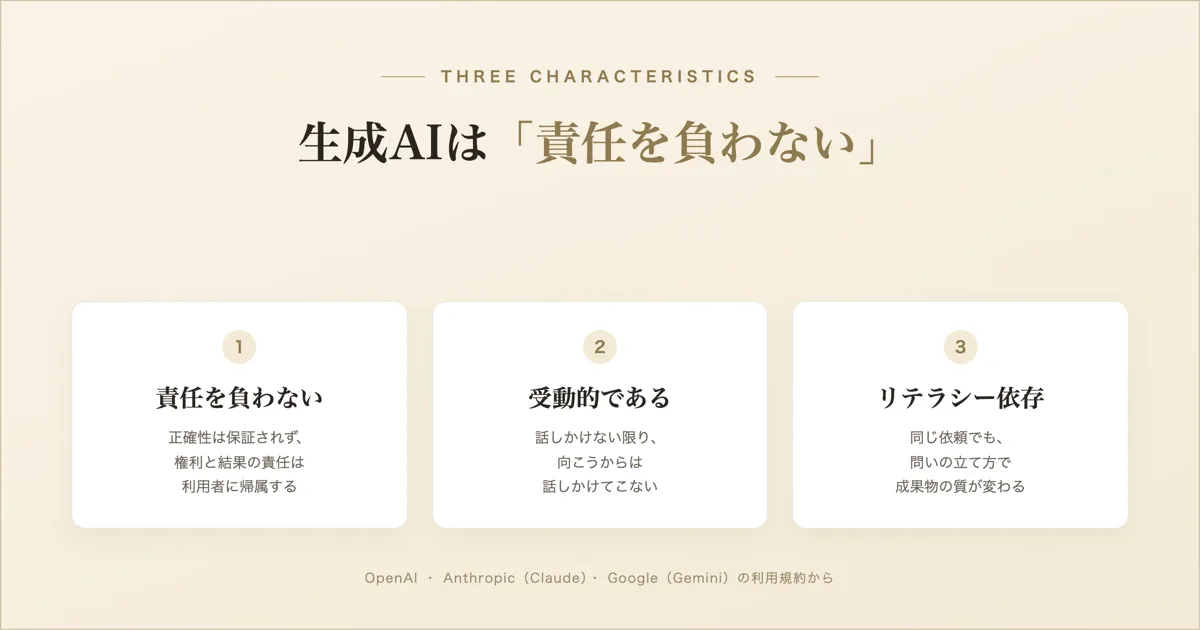
When you use generative AI in daily work, you inevitably arrive at plain questions: “How far can I trust this output?” and “Who owns the rights to what it produces?” The answers are spelled out in the terms of use each company publishes. In this article, we read the terms of use of OpenAI, Anthropic (Claude), and Google (Gemini) side by side and organize three shared traits worth keeping in mind when considering how to work with generative AI—bears no responsibility, is passive, and depends on the user’s literacy—together with quotations from the original terms.
Conclusion — the three traits converge on “can you pose a good question?”
Let us state the conclusion first. The three traits seem to say different things, but they in fact converge on a single point.
| Trait | What each company’s terms provide | Where it leads |
|---|---|---|
| ① Bears no responsibility | The accuracy of output is not guaranteed. Rights are assigned to the user, but the user also bears responsibility for the results | The one who makes the final judgment is a human |
| ② Is passive | Unless you speak to it, it will not speak to you | Unless you pose a question, nothing begins |
| ③ Depends on the user’s literacy | Even for the same request, the quality of the deliverable changes depending on premises and whether the basis is checked | The quality of the question you pose determines the result |
Below, we look at each together with the original terms.
Trait 1 — Generative AI “bears no responsibility”
“Bears no responsibility” means that neither the generative AI nor the company providing it assumes legal or practical responsibility for the correctness of the output or for its results. If you suffer a loss from wrong information, no one will make up for it. The terms of use of OpenAI, Anthropic, and Google all provide the following three points in common.
① Do not take output at face value
OpenAI clearly states that output cannot serve as a sole source of truth or as a substitute for professional advice.
Output may not always be accurate. You should not rely on Output from our Services as a sole source of truth or factual information, or as a substitute for professional advice.
(Output may not always be accurate. You should not rely on the output of these services as a sole source of truth or factual information, or as a substitute for professional advice.)
Anthropic (Claude) goes a step further, cautioning that the more detailed and specific output appears, the more it may contain errors.
Outputs may not always be accurate and may contain material inaccuracies even if they appear accurate because of their level of detail or specificity. … You should not rely on any Outputs or Actions without independently confirming their accuracy.
(Outputs may not always be accurate and, even if they appear accurate because of their level of detail or specificity, may contain material inaccuracies. … You should not rely on any outputs or actions without independently confirming their accuracy.)
Google (Gemini) takes the approach of prohibiting reliance on professional advice such as medical, legal, or financial advice, with a somewhat narrower scope than the other two companies.
Don’t rely on the services for medical, legal, financial, or other professional advice. Any content regarding those topics is provided for informational purposes only and is not a substitute for advice from a qualified professional.
(Do not rely on the services for medical, legal, financial, or other professional advice. Any content on these topics is provided for informational purposes only and is not a substitute for advice from a qualified professional.)
Whereas OpenAI and Anthropic reserve broadly, including “general accuracy,” Google’s wording is limited to “professional advice.” However, given ② and ③ below, the practical consequence—that the final check is the user’s role—is the same for all three companies.
② The rights to output belong to the user
OpenAI, in addition to the user retaining ownership of Input, clearly states that the user also owns the Output, and provides that it assigns to the user whatever rights it may hold.
you (a) retain your ownership rights in Input and (b) own the Output. We hereby assign to you all our right, title, and interest, if any, in and to Output.
(You (a) retain your ownership rights in Input and (b) own the Output. We hereby assign to you all of our right, title, and interest, if any, in and to the Output.)
Anthropic takes almost the same approach, assigning the rights to output to the user on condition of compliance with the terms.
you retain any right, title, and interest that you have in the Inputs you submit. Subject to your compliance with our Terms, we assign to you all of our right, title, and interest—if any—in Outputs.
(You retain any right, title, and interest that you have in the Inputs you submit. Subject to your compliance with our Terms, we assign to you all of our right, title, and interest—if any—in the Outputs.)
Google takes the approach of “not claiming ownership” rather than “assigning rights.”
Some of our services allow you to generate original content. Google won’t claim ownership over that content.
(Some of our services allow you to generate original content. Google will not claim ownership over that content.)
In legal construction, “assign” and “won’t claim ownership” differ, but in practice both reach the same result: the user can freely use what is generated.
③ Generative AI will not bear responsibility for you
All three companies clearly state that they do not guarantee the accuracy of their services or output, but there are differences in the degree to which liability is limited. OpenAI disclaims all warranties “AS IS.”
OUR SERVICES ARE PROVIDED “AS IS.” … WE … MAKE NO WARRANTIES … WE DO NOT WARRANT THAT THE SERVICES WILL BE … ACCURATE OR ERROR FREE. … YOU ACCEPT AND AGREE THAT ANY USE OF OUTPUTS FROM OUR SERVICE IS AT YOUR SOLE RISK.
(These services are provided "AS IS." … We make no warranties, … nor do we warrant that the services will be accurate or error free. … You accept and agree that any use of outputs from our service is at your sole risk.)
Anthropic likewise treats all of the service, output, and actions as “AS IS,” and expressly disclaims all warranties.
YOUR USE OF THE SERVICES, MATERIALS, AND ACTIONS IS SOLELY AT YOUR OWN RISK. THE SERVICES, OUTPUTS, AND ACTIONS ARE PROVIDED ON AN “AS IS” AND “AS AVAILABLE” BASIS … WE AND OUR PROVIDERS EXPRESSLY DISCLAIM ANY AND ALL WARRANTIES.
(Your use of the services, materials, and actions is solely at your own risk. These are provided on an "AS IS" and "AS AVAILABLE" basis, … and we and our providers expressly disclaim any and all warranties.)
Google alone has a difference in tone in its wording. The default (U.S.-standard) Google Terms of Service, like the other two companies, disclaims all warranties “AS IS,” but the terms displayed for certain regions including Japan add a quality-assurance clause such as the following.
We provide our services using reasonable skill and care. … Other than the liabilities described above, Google is liable only for its breaches of these terms or applicable service-specific additional terms, subject to applicable law.
(Google provides its services using reasonable skill and care. … Other than the liabilities described above, Google is liable only for its breaches of these terms or applicable service-specific additional terms, subject to applicable law.)
In other words, Google changes the construction of its terms by region, and users in Japan have applied to them a clause that goes slightly further than the other two companies: “promising a certain quality, and bearing responsibility only in the event of a breach.” Still, the point that the accuracy of the output itself is outside the scope of the warranty, and that the final responsibility rests with the user, does not change.
The conclusion common to all three companies is that the judgment to ultimately use the output, and the responsibility for its results, is borne by the user (the human).
Trait 2 — Generative AI is “passive”
The second trait is that generative AI is passive. Unless you speak to it, it will not speak to you.
For example, even if you ask it to “make me a billionaire,” it will return an answer if you convey the conditions, but it will not constantly monitor subsequent market changes and opportune events and automatically walk alongside you until you succeed. The necessary information must be provided by you each time.
Mechanisms to compensate for this passivity have also appeared. For instance, Claude Code has a command called /loop that automatically runs a prepared prompt at fixed intervals (organized in detail in “An Introduction to ‘Loop’ Design in Claude Code”). However, since /loop operates only during a session and on the PC at hand, a separate mechanism such as /schedule is needed if you want it to continue even after closing the PC. In any case, these are mechanisms in which “a human actively designs in order to compensate for passivity”; it is not that the generative AI itself has become an agent that spontaneously takes action.
Trait 3 — Final quality is likely influenced by the “user’s literacy”
The third is not a matter spelled out in the terms, but a point that emerges as you actually compare outputs. There are three things worth being aware of.
① Output tends to be safe and uniform
The output of generative AI, as a matter of principle, tends toward “general, safe answers.” To obtain a result that goes a step further, the user must organize the objective and provide the premises.
② Are you checking the basis (the facts)?
Users tend to use output without checking the basis the AI referred to. If you leave it entirely to the AI without verifying the basis, things may not proceed in the intended direction.
③ Even for the same request, the final deliverable differs from person to person
Even when asking the same AI with the same words, the quality of the final deliverable varies depending on the presence or absence of literacy. Rather than searching for a “magic prompt,” raising one’s own literacy and conveying requests broken down into fine detail is the shortcut in practice.
Summary — it comes down to “can you pose a good question?”
The three traits seem to say different things, but they in fact converge on a single point.
- Bears no responsibility → the one who makes the final judgment is a human
- Is passive → unless you pose a question, nothing begins
- Depends on the user’s literacy → the quality of the question you pose determines the result
While answers themselves have become obtainable for next to nothing, the difference shifts to “whether you hold a good question.” Those who pose good questions and act actively can increasingly make use of generative AI, while those who dump everything on the AI and remain passive are left behind—what generative AI brings may be not an “equalization” of ability but a possible “widening of the gap.”
What becomes visible as you verify terms and traits and gather more information is that, even with generative AI this widespread, humans still need to act actively. The age in which humanity can remain “passive” is, one might say, still far off.
References
- Terms of Use — OpenAI (confirmed July 10, 2026)
- Consumer Terms of Service — Anthropic (confirmed July 10, 2026)
- Google Terms of Service (confirmed July 10, 2026. The quality-assurance clause varies in content by access region; this article confirms both the U.S.-standard version and the version displayed for Japan)
- “An Introduction to ‘Loop’ Design in Claude Code: Four Loop Types and How to Use Them” — Kobayashi Shoji Blog